VO₂ Max After 50: One of the Most Important Fitness Numbers to Know
As we get older, we tend to focus more on numbers. Blood pressure. Cholesterol. Blood sugar. Weight. Resting heart rate. All of those matter.
But another number deserves much more attention after 50: VO₂ max.
VO₂ max measures cardiorespiratory fitness. It measures how effectively your heart, lungs, blood vessels, and muscles work together to deliver and use oxygen during hard exercise. Unlike many fitness metrics, VO₂ max is about much more than athletic performance. It is closely associated with how well we function, how much physical reserve we have, and how likely we are to remain active and independent as we age. That makes it one of the most useful numbers to understand in the second half of life.
What Is VO₂ Max?
VO₂ max stands for maximal oxygen uptake. It is usually expressed as milliliters of oxygen used per kilogram of body weight per minute, or ml/kg/min. In simple terms, it tells us how much oxygen your body can use when you are exercising near your maximum capacity. The higher the number, the greater your aerobic capacity.
Think of your body as a system. Your lungs bring oxygen in. Your heart pumps oxygen-rich blood. Your blood vessels deliver it. Your muscles extract and use it to produce energy. VO₂ max gives us a broad measure of how effectively that entire system works together.
Why VO₂ Max Matters More As We Get Older
VO₂ max tends to decline with age, although the rate varies considerably depending on genetics, activity level, health, and training. Research has commonly found age-related declines of roughly 1% per year, although highly active people may experience a slower decline. That matters because the activities of daily life do not become easier simply because we get older. We still need enough capacity to:
- walk uphill
- climb stairs
- carry groceries
- travel
- hike
- play with grandchildren
- work around the house
- recover from illness or injury
The lower our maximum capacity becomes, the larger the percentage of that capacity ordinary activities require.
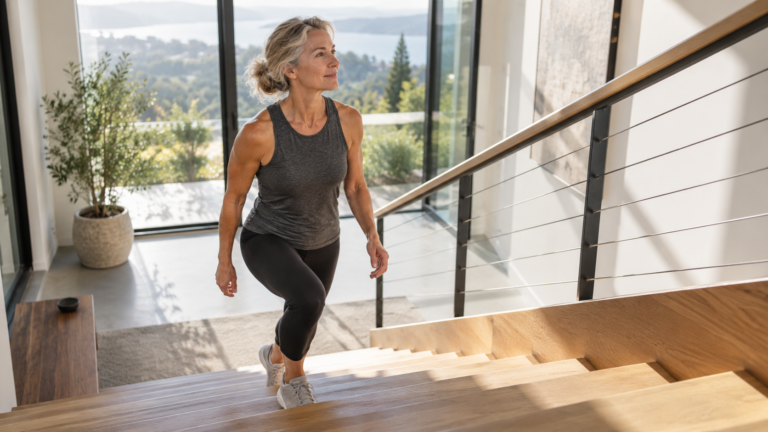
Walking up a flight of stairs may represent only a modest effort for someone with high cardiorespiratory fitness. For someone whose aerobic capacity has declined substantially, that same staircase can become a major exertion. That is why VO₂ max is not merely a sports-performance number. It measures physical reserve.
VO₂ Max and Longevity
One of the most compelling reasons to pay attention to cardiorespiratory fitness is its relationship with longevity. A large 2018 study followed more than 122,000 adults who underwent exercise treadmill testing. Researchers found a strong inverse relationship between cardiorespiratory fitness and all-cause mortality: people with higher fitness levels had lower long-term mortality risk. The study also found that the mortality risk associated with poor cardiorespiratory fitness was comparable to or greater than several traditional clinical risk factors, including smoking, diabetes, and coronary artery disease.
That does not mean improving your VO₂ max guarantees a certain number of extra years. These are associations, not promises. But the broader message is hard to ignore: Cardiorespiratory fitness is strongly associated with long-term health. And unlike age itself, fitness is something we can influence.
Think of Fitness as a Retirement Account
There is a useful way to think about this after 50. Imagine physical capacity as a retirement account. When we are younger, many of us have far more capacity than everyday life requires. We can lose some and barely notice. But over decades, that reserve can shrink. Eventually, ordinary tasks begin consuming a much larger share of what we have available.
The goal, then, is not necessarily to maintain the VO₂ max of a 25-year-old. It is to enter our 60s, 70s, and 80s with as much aerobic reserve as reasonably possible. The higher the starting point, the more room we may have to absorb the inevitable effects of aging. That is one reason I think fitness after 50 should focus less on appearance and more on capacity. What can your body still do? And what do you want it to do 20 years from now?
How Is VO₂ Max Measured?
The most accurate way to measure VO₂ max is through a laboratory exercise test. You exercise on a treadmill or stationary bicycle while wearing a mask that measures oxygen consumption and carbon dioxide production. As the workload increases, researchers can measure how much oxygen your body uses. That is the gold standard.
But most of us are not going to a sports-performance laboratory every few months. Fortunately, many modern fitness watches estimate VO₂ max using heart rate, pace, speed, age, sex, and other data. These estimates don’t match laboratory testing, but they can still help you track trends. If your watch estimates your VO₂ max at 38 today and 42 several months from now under similar conditions, the trend may tell you something useful even if neither number is perfectly precise. For most people, direction matters more than decimal-point accuracy.
What Determines Your VO₂ Max?
Several factors influence aerobic capacity. Some are outside our control.
Age
VO₂ max generally declines as we get older.
Genetics
Some people naturally begin with greater aerobic capacity or respond more strongly to endurance training.
Sex
Average VO₂ max values differ between men and women because of physiological differences including body composition and hemoglobin levels.
Body composition
Because relative VO₂ max is expressed per kilogram of body weight, changes in body mass can affect the number.
Training
This is the factor we can influence most directly. Regular aerobic exercise can improve cardiorespiratory fitness at virtually any age.
The Two Types of Training I Would Prioritize
You do not need an elaborate program to improve aerobic fitness. Most adults need only focus on two broad types of cardiovascular training.
1. Build Your Aerobic Base
This is the comfortable-to-moderate work you can sustain for an extended period. Examples include:
- brisk walking
- jogging
- cycling
- swimming
- rowing
- hiking
You should be working, but not gasping.
This type of training improves endurance and allows you to accumulate meaningful exercise volume without constantly exhausting yourself. Federal physical activity guidance for older adults recommends at least 150 minutes of moderate-intensity aerobic activity per week, or an equivalent amount of vigorous activity, along with muscle-strengthening work. That is a very good foundation.
2. Occasionally Work Hard
If your health and physical condition allow it, some higher-intensity training can provide a stronger stimulus for improving VO₂ max. That does not necessarily mean sprinting. Intensity is relative. For one person, hard intervals might mean running. For another, they might mean:
- walking rapidly uphill
- increasing resistance on a stationary bicycle
- climbing stairs
- using an elliptical
- rowing harder for short periods
The goal is to spend brief periods working at an intensity that challenges your cardiovascular system, followed by recovery. A simple example might be:
1 minute hard
2 minutes easy
Repeated several times.
You do not need every workout to be hard. In fact, it probably should not be. A combination of easier aerobic work and occasional harder efforts is usually much more sustainable.
Do Not Forget Strength
VO₂ max is primarily a measure of aerobic fitness, but cardiovascular capacity is only part of healthy aging. Muscle matters too. The ability to walk, climb, lift, carry, balance, and remain independent depends on both aerobic capacity and strength. That is why physical activity guidance for older adults also recommends muscle-strengthening exercise at least two days per week and activities that include balance work. If aerobic fitness is your engine, muscle is part of the chassis that allows you to use it. We need both.
The Goal Is Not to Become an Endurance Athlete
This is an important point. You do not need an elite VO₂ max. You do not need to train for a marathon. You do not need to become obsessed with a number on your watch. For most people over 50, the more practical objective is to keep improving your capacity relative to where you are today.
If you are sedentary, begin walking. If you walk regularly, add hills. If hills become easy, occasionally increase the pace. If you already exercise consistently, introduce structured intervals. Progress gradually. Fitness is remarkably responsive when we give the body a reason to adapt.
Measure the Trend, Not Your Ego
Wearables have made VO₂ max more visible, which is useful. But they can also tempt us to turn health into a competition. That misses the point. You should primarily compare your VO₂ max with your previous VO₂ max.
Is your cardiovascular fitness improving? Stable? Declining?
That trend may be far more useful than comparing yourself with someone 20 years younger or an endurance athlete on social media.
Fitness Is Something We Can Still Build
One of the most encouraging things about aging is that decline is not entirely passive. We cannot stop the clock, but we can influence how much physical capacity we carry forward. We can walk. We can run. We can cycle. We can swim. We can climb. We can lift. We can challenge our cardiovascular systems.
And when we consistently ask our bodies to do difficult things, they adapt. That matters enormously after 50, because the goal is not simply to live longer; it is to preserve enough capacity to keep doing the things that make those additional years worth having.
VO₂ max is not the only measure that matters. But it is a very good reminder of something I believe is central to The Next 50: We should not merely add years to our lives. We should keep building the physical capacity to live those years well.
The Next 50 is about building the strength, health, curiosity, and capacity we want to carry into the decades ahead.