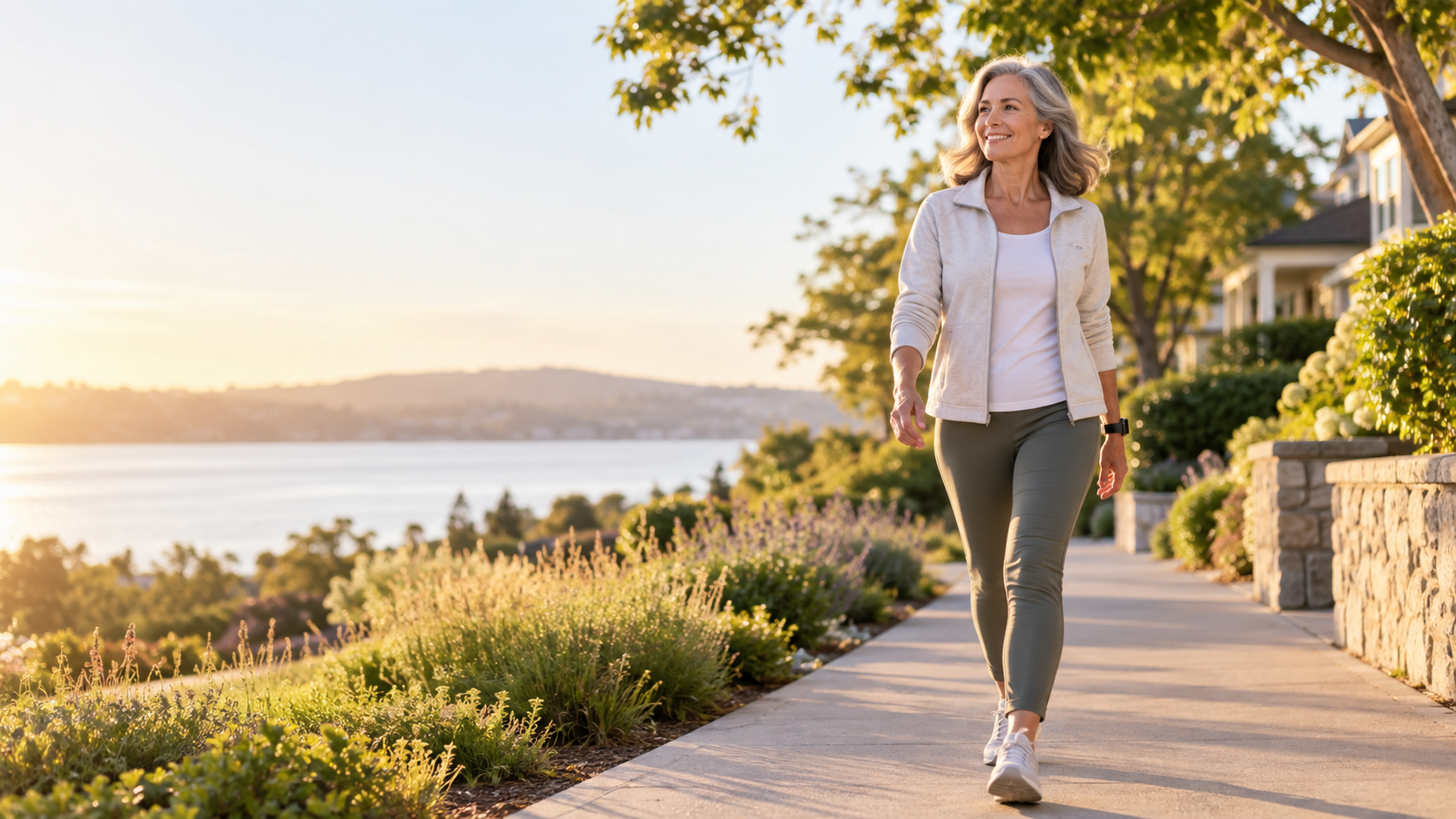
How to Build a Daily Walking Habit After 50
Walking is one of the simplest and most effective habits for healthy aging. It can support heart health, improve mood, help maintain mobility, and reduce the risk of chronic disease. Most people already know walking is good for them. The harder part is turning it into something they actually do every day.
The good news is that building a daily walking habit does not require expensive gear, a gym membership, or a major lifestyle overhaul. It starts with a few practical steps and a commitment to consistency over perfection. If you are trying to get more active, restart a routine, or build a habit that can serve you for years to come, walking is a great place to start.
Start Where You Are
One of the fastest ways to fail is to begin with an unrealistic goal. Many people feel like they should immediately aim for 10,000 steps a day. But if you are currently walking very little, that number can feel overwhelming. A better strategy is to start where you are and build from there. If needed, begin with just 10 to 15 minutes a day. That is enough to establish the habit. Over time, you can gradually increase your time, distance, or pace. At the beginning, the goal isn’t intensity. It is consistency.
Schedule It Like an Appointment
If walking matters to you, put it on your calendar. Choose a time that fits naturally into your day. That might be in the morning, at lunch, after dinner, or during a work break. The more predictable the time, the easier it is to repeat the behavior until it becomes automatic.
During the week, it is very difficult for me to get out of the house after getting home from work. As a result, I leave for my daily walk from the office. I will aim to leave between 5:00 and 5:30 pm. My 5 1/2 mile walks generally take an hour and a half. Even on days I have to work late, I go out for my walk and come back to the office with a clear mind and renewed energy to finish whatever still needs to be done. It helps me to attach walking to an existing habit (e.g., the clock hitting 5:00 pm). Examples also include:
- After finishing your morning coffee, you go for a 15-minute walk.
- After lunch, you walk around the block.
- After dinner, you take a short walk before settling in for the night.
Atomic Habits author James Clear describes habit stacking as attaching a new habit to something you already do consistently. The existing habit becomes the cue for the new behavior.
Make It Easy to Succeed
The easier a habit is to start, the more likely you are to keep it going. Set out your walking shoes where you can see them. Pick routes that are simple, safe, and familiar. If the weather is bad or your neighborhood is not ideal, find alternatives like a mall, a treadmill, an indoor hallway, or a local track. Do not make walking complicated or a chore. Make it convenient.
Focus on Enjoyment, Not Just Exercise
Walking is more sustainable when it feels rewarding. Listen to music, a podcast, or an audiobook. Walk with your spouse, a friend, or the dog. Use the time to think, de-stress, pray, or simply enjoy being outside. The more you look forward to walking, the easier it will be to keep doing it. This matters even more after 50. At this stage of life, the best exercise program is often the one you will actually keep doing.
One of my favorite walking activities is listening to books through Audible. My walks last between one and two hours. During that time, I can listen to a substantial portion of a book I’m interested in. Although my favorites are typically non-fiction, I also frequently listen to fiction, including 1984, Hitchhiker’s Guide to the Galaxy, and Fahrenheit 451.
Track Progress, But Do Not Obsess
Tracking can be useful, but it should support the habit, not control it. A smartwatch, phone, or step counter can help you notice patterns and stay encouraged. But instead of obsessing over exact numbers, focus on simple signs of progress:
- Are you walking more days this week than last week?
- Are your walks lasting a little longer?
- Are you moving more easily?
- Do you feel better after your walks?
I use a Garmin 55 to track my walks. I have the watch connected to the Garmin app on my iPhone. I have found that seeing my daily progress encourages me to continue. I see the trend and feel motivated to keep it going all week. It’s really cool to see that I walk hundreds of thousands of miles at the end of each month. It reinforces my desire to get my steps in.
Have a Backup Plan
Life will interrupt your routine from time to time. Travel, weather, work, and family obligations can all get in the way. That is why it helps to have a Plan B. If you cannot do your usual walk, try one of these alternatives:
- Walk indoors while taking phone calls
- Walk the airport terminal before a flight
- Use a hotel treadmill while traveling
- Do laps in a hallway, garage, or around the house
A strong habit is not built by never missing a day. It is built by finding ways to keep going when conditions are not perfect. I look forward to getting outside after work every day. On some days, when the weather is really bad, I use the walking pad that I keep next to my desk. This lets me keep moving, even when the weather is horrible. While walking at my desk isn’t the same as being out in nature, I feel satisfied knowing I kept my weekly streak alive.
Celebrate Consistency, Not Perfection
Walking habits are built over time, not in one heroic week. You do not need to be perfect. You just need to keep coming back. Missing a day or two does not mean you have failed. What matters is getting back on track without turning a short lapse into a long one.
Celebrate small wins:
- A full week of daily walks
- A longer walk than usual
- A full month of staying consistent
- Choosing the walk when you did not feel like it
Those small wins build momentum, and momentum is what turns effort into identity.
Final Thought
Building a daily walking habit is not about chasing perfection or trying to impress anyone. It is about showing up for your body in a simple, sustainable way. Especially after 50, walking offers a practical, joint-friendly, heart-healthy way to stay active. It can help you maintain energy, mobility, and confidence as the years go on. Start small. Keep it simple. Stay consistent. Because sometimes the most ordinary habits have the biggest long-term impact.
The Next 50 is about building the strength, health, curiosity, and capacity we want to carry into the decades ahead.
Disclosure: This page may contain affiliate links. If you purchase through one of these links, I may earn a small commission at no additional cost to you.