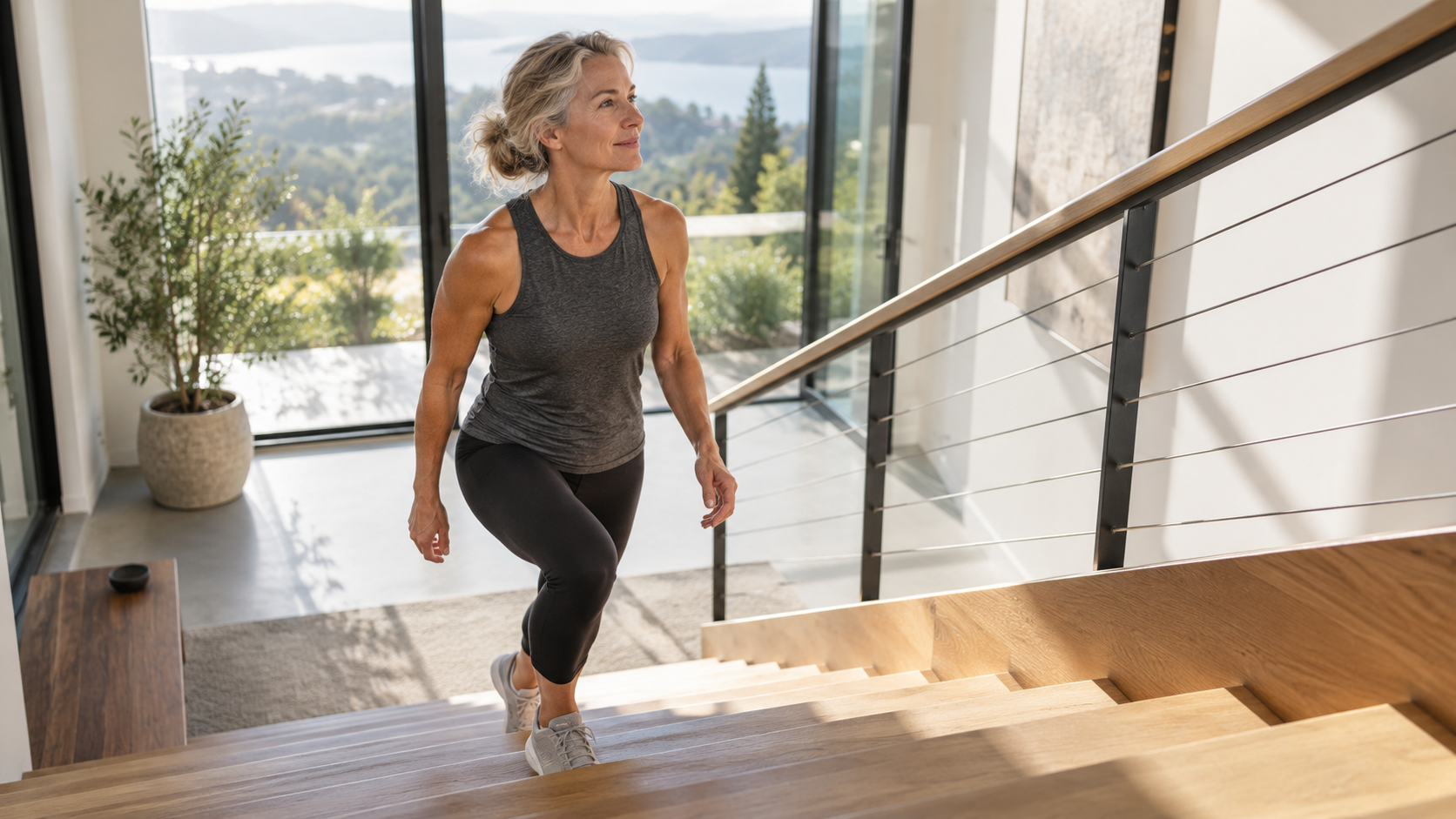
The Staircase Test: One of the Simplest Measures of How Well You’re Aging
A remarkably simple test of physical aging is one most of us encounter every day: the staircase. When you see one, what is your instinct?
Do you take the stairs without thinking? Do you pause and wonder whether your knees will cooperate? Do you reach the top mildly winded or completely out of breath? Or do you automatically look for the elevator?
Those reactions may tell us more about our health than we realize.
Being married to a personal trainer has taught me something that sounds obvious but is surprisingly easy to forget: Everyday life does not always have to be done the easy way.
At the supermarket, we often park farther from the entrance instead of searching for the closest possible space. When we can roll groceries to the car or carry the bags ourselves, we often carry them. And when a staircase sits next to an elevator, we usually take the stairs.
None of these things qualify as a workout. But together they reflect a simple philosophy: When everyday life gives you an opportunity to move, lift, carry, walk, or climb—take it.
That philosophy now has some interesting research behind it.
A 2026 systematic review and meta-analysis involving more than 480,000 people found that regular stair climbing was associated with lower mortality. The pooled analysis reported about a 24% lower risk of death from any cause and a 39% lower risk of cardiovascular death among people who climbed stairs more regularly. Those are attention-grabbing numbers.
But the more interesting question, especially for those of us over 50, may be this: Is the staircase beneficial because we climb it—or does our ability to climb it tell us something about how well our bodies are functioning? Probably some of both.
A Staircase Is Surprisingly Demanding
Walking across a parking lot and climbing a staircase are both forms of movement, but physiologically they are very different.
When you climb stairs, you repeatedly lift your body against gravity. Your quadriceps extend the knee. Your glutes extend the hip. Your calves propel you upward. Your core stabilizes your body. Your balance and coordination systems make constant adjustments. Your heart and lungs rapidly increase oxygen delivery to working muscles.
Anyone who has rushed up several flights knows how quickly heart rate and breathing can rise.
That makes stair climbing unusual. It combines cardiovascular exercise, lower-body resistance work, balance, and coordination in an activity already built into everyday life. No gym membership. No equipment. No workout clothes. Just gravity.
Be Careful With the Big Numbers
The 24% and 39% figures are encouraging, but they should not be interpreted as guarantees. The 2026 review pooled mostly observational research. That means researchers observed how stair-climbing habits related to later health outcomes; they did not randomly assign people to “take the stairs” and “never take the stairs” groups for years.
That distinction matters. People who climb stairs regularly may already differ from people who avoid them. They may:
- exercise more
- have stronger legs
- have better cardiovascular fitness
- carry less excess weight
- have fewer mobility limitations
- have fewer chronic health problems
Researchers try to adjust statistically for these differences, but observational studies cannot eliminate every source of confounding. So the most useful message is not:
“Take the stairs and cut your risk of cardiovascular death by exactly 39%.”
It is:
Being physically capable of regular stair climbing appears to be associated with better health outcomes, and stair climbing itself can help maintain that capability. That is a much more useful idea.
The Staircase as a Functional Aging Test
One mistake we can make when thinking about aging is focusing exclusively on laboratory numbers. What is my cholesterol? What is my blood pressure? What is my fasting glucose? What is my weight?
Those things matter. But another question becomes increasingly important as we get older: What can my body still do?
Can I get off the floor without assistance? Can I carry groceries? Can I walk several miles? Can I maintain my balance? Can I lift something overhead? Can I climb several flights of stairs? Those are not vanity metrics. They are measures of functional capacity.
Imagine two people, both 55, who can comfortably climb six flights of stairs today. One gradually stops challenging his body. The other keeps walking, lifting, climbing, carrying, and training. Twenty years later, neither will have exactly the same physical capacity they had at 55. Aging changes all of us. But they may start that decline from very different places.
That is why maintaining physical capacity matters so much. We are not merely training for today. We are building reserve for tomorrow.
Small Choices Add Up
This is where the mundane choices matter. The extra walk across the parking lot is not impressive. Carrying groceries instead of rolling them to the car is not impressive. Taking two flights of stairs instead of an elevator is not impressive. But longevity is rarely built on one heroic act.
It is more often built from hundreds of small choices repeated for years. And because some of those choices require relatively high effort, they may provide a different stimulus than slow, easy movement alone.
Meet VILPA
Researchers have also been studying something called Vigorous Intermittent Lifestyle Physical Activity, or VILPA. VILPA refers to short bursts of vigorous movement embedded in ordinary life rather than structured exercise.
Examples might include:
- climbing stairs quickly
- walking briskly uphill
- carrying heavy bags
- rushing to catch a train
- moving heavy objects
- short bursts of fast walking
In a UK Biobank study of more than 25,000 people who reported no structured exercise, brief bouts of VILPA measured by wearable devices were associated with lower mortality. The study found that even a few short bouts per day were linked with lower all-cause, cardiovascular, and cancer mortality. Again, these were observational findings, not proof that VILPA directly reduced risk. But the concept is useful because it changes the way we think about exercise.
Your body does not know whether you are raising your heart rate because you are wearing workout clothes or because you are carrying four bags of groceries across a parking lot. It responds to physical demand. That opens an important door for people who think they don’t have time to exercise.
You may not have an hour. But you probably have a minute. And a minute of challenging movement, repeated several times during the day, can still be meaningful.
Instead of Always Asking, “How Can I Make This Easier?”
Occasionally ask:
How can I make this a little more physical?
Take the farther parking space. Carry the bags. Take the stairs. Walk instead of driving when practical. Choose movement when convenience is not necessary. These are not punishments. They are opportunities.
So How Many Stairs?
One large UK Biobank study looked at daily stair climbing in more than 280,000 participants and grouped them into categories ranging from no stair climbing to 16 or more flights per day. The lowest all-cause mortality risk was observed in the group reporting roughly 6–10 flights per day, although the effect was modest and the authors cautioned that residual confounding remained a concern.
That does not mean six flights is a magical longevity prescription. It simply gives us a practical target. Think of it the same way many people think about daily step goals: not as a medical threshold, but as a behavioral cue.
The Six-Flight Habit
Here is a simple experiment: For the next month, try accumulating about six flights of stairs per day. You do not have to climb them all at once. Two flights in the morning. Two around lunch. Two later in the day. Done.
If six flights eventually become easy, you can occasionally climb them a little faster. Now you are adding another useful stimulus: intensity.
Do Not Turn the Staircase Into a Competition
Especially after 50, the goal is to improve capacity, not prove something.
Aggressive stair climbing may not be appropriate if you have significant:
- knee or hip problems
- balance issues
- cardiovascular disease
- dizziness
- unexplained severe shortness of breath
- recent surgery
- neurological conditions
Use railings when appropriate. Wear proper footwear. Start slowly. And remember that descending stairs can be particularly demanding on the knees. There is no longevity prize for getting injured.
Your Staircase Report Card
Instead of thinking of stairs only as exercise, use them occasionally as a simple self-check. After climbing several flights, notice: How hard are you breathing? How quickly does your breathing return toward normal? Do your thighs feel strong or exhausted? Do you feel stable? Do your knees or hips hurt? Does the climb feel routine—or intimidating?
You do not need to turn this into a formal medical test. Just pay attention. If something that was easy a year ago suddenly becomes difficult, do not automatically dismiss it as: “I’m just getting older.”
A change in functional capacity may be worth understanding. Sometimes age is part of the explanation. Sometimes reduced activity is part of the explanation. And sometimes a meaningful change deserves medical attention.
Do Not Just Add Years to Your Life
When we talk about longevity, it is easy to become obsessed with lifespan. But I think a more important question is: How long can we remain capable?
Capable of traveling. Capable of hiking. Capable of carrying luggage. Capable of playing with grandchildren. Capable of getting off the floor. Capable of living independently. Capable of carrying our own groceries across the parking lot. Capable of climbing the stairs.
The goal is not simply to reach 90. The goal is to arrive there with as much strength, mobility, cardiovascular capacity, and independence as we can preserve.
Modern life continually removes physical effort from our days. Escalators remove it. Elevators remove it. Cars remove it. Delivery services remove it. Remote controls remove it.
Technology has made life wonderfully convenient. But our bodies were not designed to thrive on convenience alone. Sometimes the healthier choice is to deliberately choose the slightly harder path.
The Next Time You See a Staircase
Try looking at it differently. Not as an inconvenience. Not merely as transportation between floors. But as a small piece of exercise equipment hiding in plain sight.
A staircase gives your heart something to do. It gives your legs something to do. It challenges balance and coordination. It tests your physical capacity. And unlike most exercise equipment, staircases are everywhere.
The same principle applies to countless other small decisions. Park farther away. Carry something. Walk a little more. Take the stairs.
Not because making life unnecessarily difficult is virtuous. But because every time you choose movement over convenience, you cast a small vote for the person you hope to be ten, twenty, or thirty years from now: Strong. Mobile. Independent. And still taking the stairs.
The Next 50 is about building the strength, health, curiosity, and capacity we want to carry into the decades ahead.